
Being available after publishing helps you answer real questions while the idea is fresh. It does not establish a universal sixty-minute deadline for a post to succeed.
The decision this guide helps you make
Schedule your response time around the audience and your capacity. A useful discussion may develop later, particularly when readers work across time zones.
A practical workflow
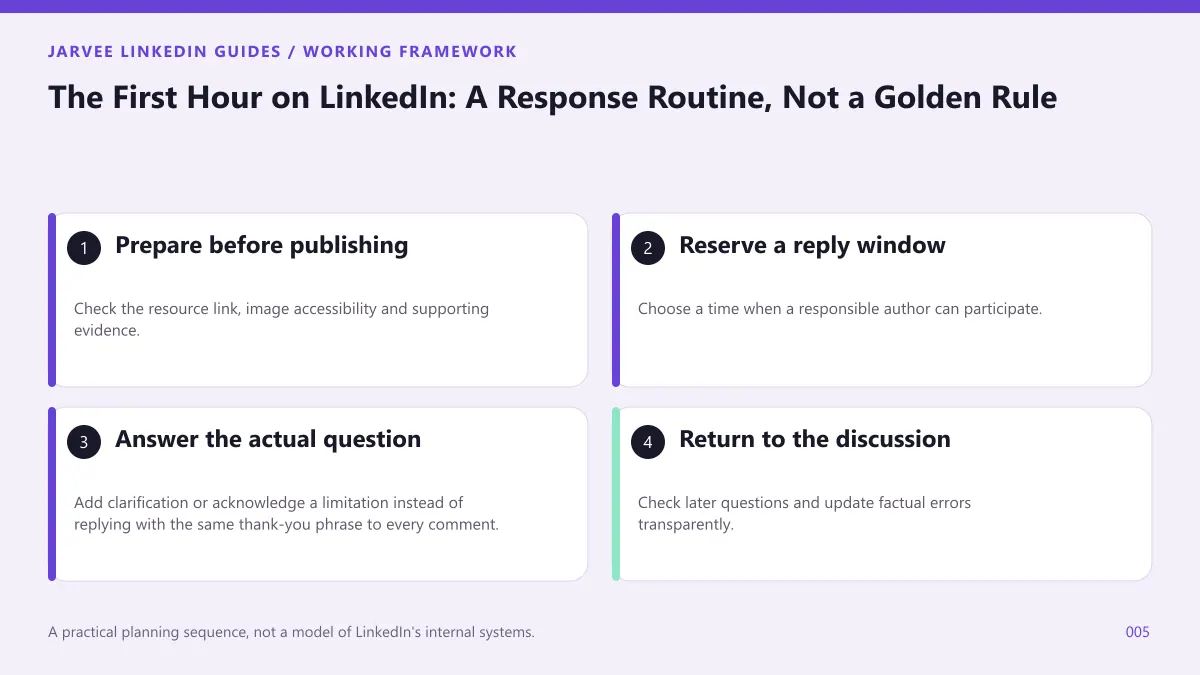
1. Prepare before publishing
Check the resource link, image accessibility and supporting evidence. Have the underlying calculation or example ready if readers ask for detail.
2. Reserve a reply window
Choose a time when a responsible author can participate. Do not post a sensitive claim immediately before leaving the account unattended.
3. Answer the actual question
Add clarification or acknowledge a limitation instead of replying with the same thank-you phrase to every comment. Move confidential details to an appropriate private channel with permission.
4. Return to the discussion
Check later questions and update factual errors transparently. A post remains an editorial responsibility after the first response window ends.
An illustrative application
A founder publishes a product tradeoff and sets aside a short reply block, then checks again the following day. A technical objection becomes a clarification in the post rather than an argument designed to accumulate comments.
Prepare for the questions the post creates
Before publishing, identify which parts of the explanation are most likely to need clarification. A calculation may need its assumptions; a process example may need an exception; a product statement may need an availability note. Keep those details accessible to the responsible author so the first useful question receives an informed response rather than an improvised claim.
Sensitive questions need a different route. A reader may reveal a customer problem, employer detail or account issue in a comment. Do not ask them to publish more private information to keep the thread active. Explain the appropriate support or private contact route and collect only what is necessary for the actual issue.
Use a response queue instead of a reaction quota
A small response queue can distinguish unanswered questions, corrections, support requests and ordinary discussion. Assign an owner and a reasonable next action. This helps a team avoid answering the easy compliments while overlooking the difficult question that would materially improve the post.
Responses should add something. If several readers ask the same question, clarify the original explanation and acknowledge the update where appropriate. If a comment exposes a genuine mistake, correct it plainly. Do not preserve an error because the ensuing debate increases visible activity. The purpose of participation is a better shared understanding.
Plan coverage across time zones
Your audience may read the post while the author is unavailable. Make the original explanation sufficiently complete that it can stand without immediate replies. Schedule a later review window and explain response expectations when the subject requires support. A professional account does not need to simulate continuous personal availability.
After a publishing cycle, review the response backlog and the kinds of questions received. If every post creates more unanswered work than the team can handle, reduce complexity or frequency. A sustainable response routine is an operating choice you can verify. It should not be sold internally as a universal first-hour rule or a guaranteed way to obtain additional distribution.
Make a handover for unanswered questions
If several people support the account, use a concise handover containing the public post, the unresolved question, the responsible reviewer and the promised next action. Do not paste private customer details into a broad editorial channel. The person taking over should know enough to respond accurately without having to reconstruct the whole discussion or repeat a request for information already supplied.
Review the handover after a busy publication. Did a question fall between teams? Did two people give conflicting answers? Did a support request receive only a generic acknowledgment? These findings can improve ownership and preparation. They do not require a claim that the response happened inside a special distribution window. A reliable answer delivered through a clear process is a practical benefit the team can verify.
Keep corrections visible to the people maintaining related resources, so a clarified answer is carried into future drafts and documentation.
A working exercise
Add response coverage to the publishing calendar. Name who can answer technical questions and what should happen when a comment needs a correction or private support. Keep a short handover note for later replies. This turns availability into a service process rather than an attempt to satisfy a supposed algorithm timer.
A review checklist
| Review point | Question to answer |
|---|---|
| Before publication | Check the claim and destination |
| Initial coverage | An accountable author is available |
| Escalation | Technical questions reach the appropriate reviewer |
| Later review | Unanswered questions are checked again |
What to measure
Track unresolved questions and response quality alongside available post analytics. Do not claim that your reply routine caused every additional impression.
A mistake worth avoiding
Coordinated reaction groups and automated generic replies can make a busy comment section less credible.
Where a tool fits in this workflow
For a product-specific reference, review SMTasker LinkedIn comment capabilities. A public-comment capability is not the same as an informed reply routine. The author still needs to read the question, check relevant evidence and decide whether a correction or private support route is appropriate. Keep that responsibility explicit in the publishing plan rather than using generic prepared responses to create the appearance of immediate personal participation. Any tool use must be assessed against LinkedIn’s rules; device type does not guarantee permission or freedom from restrictions.
Frequently asked questions
Is the first hour a universal success deadline?
No. Do not treat a convenient response window as a documented distribution rule.
Must I reply to every comment immediately?
Prioritize useful questions and corrections. A considered answer is more valuable than a rushed generic reply.
Continue with the next useful question
Related guidance: A weekly LinkedIn workflow for B2B teams; LinkedIn Reach Dropped? Diagnose the Change Before Reacting.
Official reference: LinkedIn engineering: how the feed is evolving. Check current official guidance and the options available in your own account when applying feature-specific advice.