
A reach decline is a signal to investigate, not proof of a hidden penalty. Begin by distinguishing account notices, measurement changes and ordinary variation.
The decision this guide helps you make
Your publishing record can reveal what changed, but it cannot expose LinkedIn's private ranking decisions. Keep observations separate from explanations you have not verified.
A practical workflow
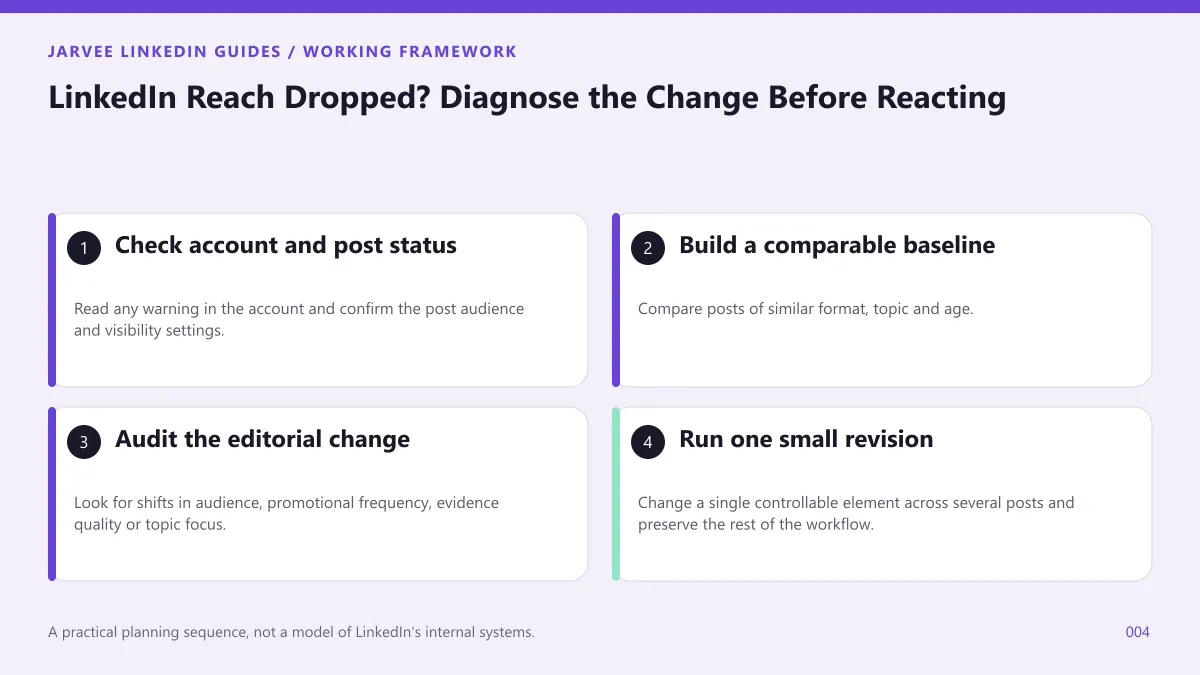
1. Check account and post status
Read any warning in the account and confirm the post audience and visibility settings. Use the official support route when an actual restriction is shown.
2. Build a comparable baseline
Compare posts of similar format, topic and age. A fresh post and a month-old post are not equivalent observations.
3. Audit the editorial change
Look for shifts in audience, promotional frequency, evidence quality or topic focus. Review whether the promised answer is still relevant to the people following you.
4. Run one small revision
Change a single controllable element across several posts and preserve the rest of the workflow. Write down the hypothesis before seeing the result.
An illustrative application
A team moves from practical implementation notes to daily launch announcements and notices weaker discussion. It tests a return to problem-solving posts rather than assuming the account needs a secret reset.
Check measurement before diagnosing distribution
Confirm that the figures being compared describe the same thing. Impressions, distinct reach and website visits answer different questions. A change in reporting window can also create an apparent decline. If one screenshot was taken after a day and another after a week, the comparison begins with a timing problem rather than an explanation of feed behavior.
Next, inspect the publishing record for changes that a reader would notice. Did the account begin addressing a different role? Did practical examples give way to repeated announcements? Did a supporting resource stop working? These are observable changes you can investigate without claiming to know why an individual ranking decision occurred.
Use a diagnostic decision tree
Start with an actual account notice, if one exists. A restriction requires the official account process and should not be treated as an editorial experiment. If there is no notice, check visibility and audience settings. Then review measurement consistency, content relevance and external context. This order helps prevent a team from making several unrelated changes before establishing the basic facts.
For an editorial test, write a hypothesis that could be wrong. 'Our recent posts no longer answer the audience's implementation questions' is more useful than 'the algorithm dislikes us'. It suggests a repair and a way to inspect the response. Publish a small set of useful answers, record comparable observations and ask relevant readers what remains unclear.
Preserve the learning even when reach remains uncertain
A repaired resource link or clearer explanation is still a concrete improvement if distribution does not immediately rise. Record those outcomes separately. Otherwise the team may discard worthwhile work because it did not move an unrelated number during a short observation period.
Set a review date and a stopping rule for the experiment. Decide what evidence would support another cycle and what would make you reconsider the hypothesis. Do not keep changing tactics until one post produces a satisfying result and then declare the last change responsible. That approach selects a story after seeing the outcome instead of testing a meaningful question.
Inspect the resource behind the post
A destination audit can reveal problems that a feed theory misses. Check whether a linked guide still matches its title, whether a form works and whether mobile visitors can access the material. Review any recent change in access conditions. A resource moved behind a demanding form may receive fewer completed uses even if the post's exposure is unchanged. Keep that finding separate from distribution. Repair the journey, record the change and observe again. This prevents the team from adjusting publishing behavior to compensate for a broken destination while leaving the actual reader problem unresolved.
Give every diagnosis a named reviewer so an attractive explanation is challenged before it becomes the team's operating assumption.
A working exercise
Create an incident note with two columns: observations and hypotheses. Put the exact reach change and account notice, if any, in the first column. Put suspected causes in the second. Review the list with someone who did not design the campaign. Their job is to identify alternative explanations and missing comparisons before the team changes the process.
A review checklist
| Review point | Question to answer |
|---|---|
| Observation | Comparable posts reached fewer relevant readers |
| Change | More launch announcements in the recent period |
| Hypothesis | The content mix became less useful |
| Test | Restore practical explanations while recording comparable observations |
What to measure
Compare median reach and relevant replies across a defined set. Annotate holidays, campaign changes and unusual outliers rather than hiding them in an average.
A mistake worth avoiding
Repeatedly deleting and reposting, mass messaging or buying reactions makes the diagnosis less reliable and can create additional problems.
Where a tool fits in this workflow
For a product-specific reference, review SMTasker LinkedIn automation overview. During a reach review, record any change in the execution setup as one observable variable. Do not replace the workflow repeatedly while also changing topic and cadence, then assign the result to the last tool used. Preserve the approved content and account context so the team can distinguish an operational failure from an unresolved editorial hypothesis. Any tool use must be assessed against LinkedIn’s rules; device type does not guarantee permission or freedom from restrictions.
Frequently asked questions
Does lower reach prove a shadowban?
No. It does not identify a cause by itself; inspect account notices and comparable evidence first.
Should I delete the underperforming posts?
Usually preserve the record for diagnosis. Correct factual errors appropriately rather than deleting merely to chase a metric.
Continue with the next useful question
Related guidance: A weekly LinkedIn workflow for B2B teams; How the LinkedIn Feed Works: A Practical Guide to Relevance.
Official reference: LinkedIn engineering: how the feed is evolving. Check current official guidance and the options available in your own account when applying feature-specific advice.