
A useful LinkedIn post starts with a professional problem, not a theory about secret ranking weights. Treat distribution as an outcome to investigate rather than a machine you can reliably manipulate.
The decision this guide helps you make
LinkedIn describes an evolving, personalized feed. Public engineering explanations do not provide a universal formula that turns comments, reading time or posting frequency into a guaranteed reach multiplier.
A practical workflow
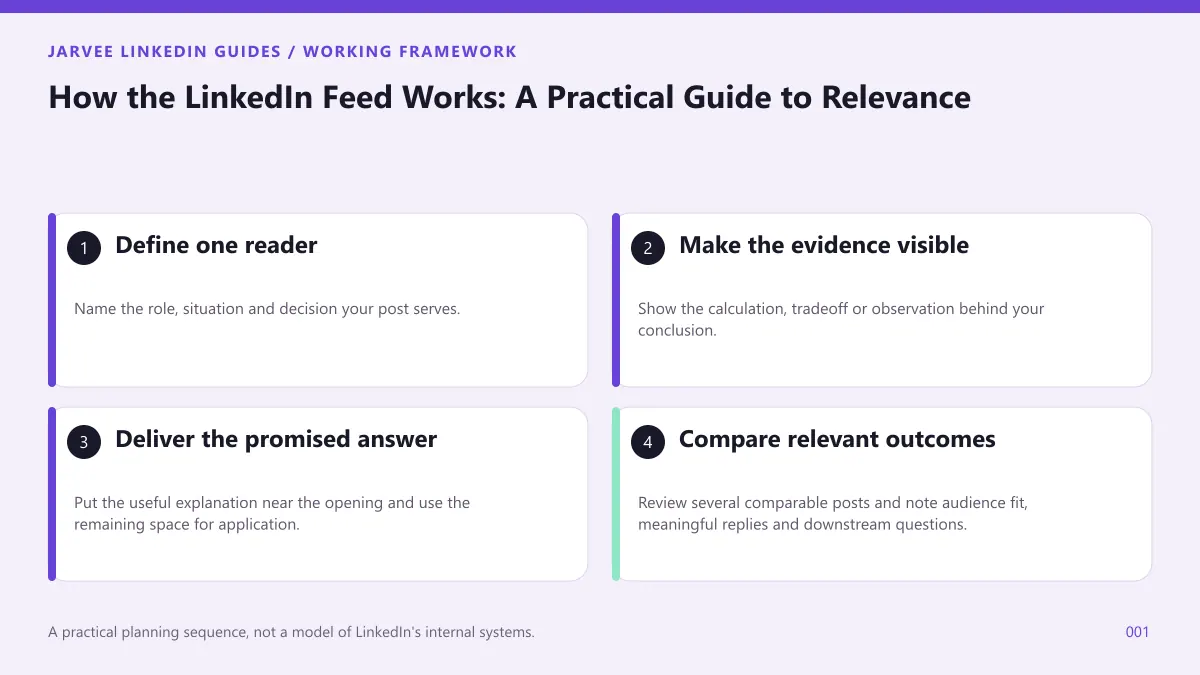
1. Define one reader
Name the role, situation and decision your post serves. A finance leader reviewing software renewals needs a different example from a founder preparing a first sales hire.
2. Make the evidence visible
Show the calculation, tradeoff or observation behind your conclusion. Replace an unsupported industry statistic with a clearly labeled example or a source you can inspect.
3. Deliver the promised answer
Put the useful explanation near the opening and use the remaining space for application. Withholding the answer to manufacture reading time makes the post harder to trust.
4. Compare relevant outcomes
Review several comparable posts and note audience fit, meaningful replies and downstream questions. A single high-impression post cannot identify what the ranking system rewarded.
An illustrative application
A hypothetical operations consultant compares two posts about handovers. One makes a broad claim about productivity; the other shows a three-field handover record and explains when to use it. The second gives the intended reader something concrete to assess, without needing a claim about algorithm weights.
Separate discovery from commercial relevance
A feed introduces material to people in different professional situations. Some already know the author; others encounter an unfamiliar idea through their broader interests or network. That makes the opening an orientation device. It should tell a new reader what the issue is without requiring them to know your company, your previous posts or the campaign behind the piece.
Commercial relevance is a separate question. A widely discussed management observation may attract readers who will never need your service. A narrow explanation of renewal ownership may reach fewer people while helping precisely the team you can serve. Neither observation establishes a ranking rule. They illustrate why the objective must be chosen before the post is assessed.
Build a fair comparison notebook
Use one row for each post and preserve the original version. Record the format, topic, intended reader, supporting resource and the age of the post when you collect its figures. Add a note when an unusual event changes the context, such as a product announcement or an external mention. These details make later comparisons more useful than a screenshot of the highest-performing post.
Suppose you want to investigate whether concrete examples help your audience. Prepare several explanations with examples and compare them with similar explanations that do not have them. Keep the offer and reader as consistent as possible. You will still have uncertainty because organic audiences are not controlled experimental groups. Describe the result as evidence from your own publishing record, not a discovery about universal model weights.
Decide what to do after the review
Finish the review by choosing a specific editorial action. You might keep a useful example, remove an unclear claim or develop a resource answering a recurring question. Avoid an action such as 'increase engagement' unless you can explain which reader need it serves. The action should be understandable to the next person producing content, including someone who has never seen the analytics dashboard.
Keep a short list of unresolved questions. If the evidence does not distinguish between audience mismatch and an unclear explanation, say so and plan a narrower observation. An honest unknown is useful because it prevents the team from organizing weeks of work around a confident but unsupported story about the feed.
Apply the brief to a different professional audience
For a recruitment adviser, the same method might begin with a hiring manager deciding how to prepare interview feedback. The evidence could be a fictional evaluation record with clearly defined criteria. The post would explain one decision and its limitations, while the review would examine relevant questions from hiring practitioners. Nothing in that exercise requires a claim about the feed assigning a fixed value to a particular interaction.
A working exercise
Prepare a one-page post brief before writing. Choose a role you genuinely understand and one decision that role faces. Save the draft and the reason behind the example, then review several posts together instead of explaining a result after the fact. The brief should remain useful even if the post receives little distribution.
A review checklist
| Review point | Question to answer |
|---|---|
| Reader | Operations director reviewing renewals |
| Question | Which approval owner is missing? |
| Evidence | A fictional completed responsibility record |
| Review | Relevant questions and resource use after a consistent observation window |
What to measure
Record the post topic, format, intended audience, members reached and relevant conversations. Keep commercial outcomes in a separate field so exposure is not mistaken for revenue.
A mistake worth avoiding
Avoid buying engagement, coordinating artificial comments or describing your own small experiment as proof of a platform-wide rule.
Where a tool fits in this workflow
For a product-specific reference, review SMTasker LinkedIn automation overview. Publication is only one part of a relevance plan. Keep the audience brief, example and evidence review separate from the mechanism used to execute an account action. The documentation is useful for checking scope before choosing a workflow; it cannot tell an editor which claim will interest a particular professional audience or how the feed will distribute it. Any tool use must be assessed against LinkedIn’s rules; device type does not guarantee permission or freedom from restrictions.
Frequently asked questions
Can I calculate LinkedIn's ranking weights from my posts?
No. Your account observations are affected by audience, topic, timing and other variables. They do not expose the platform's private model.
What should I change first when a post is unclear?
Rewrite the reader's question and the promised answer before adjusting cadence, hashtags or formatting.
Continue with the next useful question
Related guidance: A weekly LinkedIn workflow for B2B teams.
Official reference: LinkedIn engineering: how the feed is evolving. Check current official guidance and the options available in your own account when applying feature-specific advice.