
A social selling score is not a forecast of feed reach or closed business. Evaluate your LinkedIn work using the relationships and opportunities it actually creates.
The decision this guide helps you make
LinkedIn's own SSI resource now explains the limitations of the old benchmark and shifts attention toward modern sales workflows. There is no sound basis for claiming that a particular SSI score unlocks organic distribution.
A practical workflow
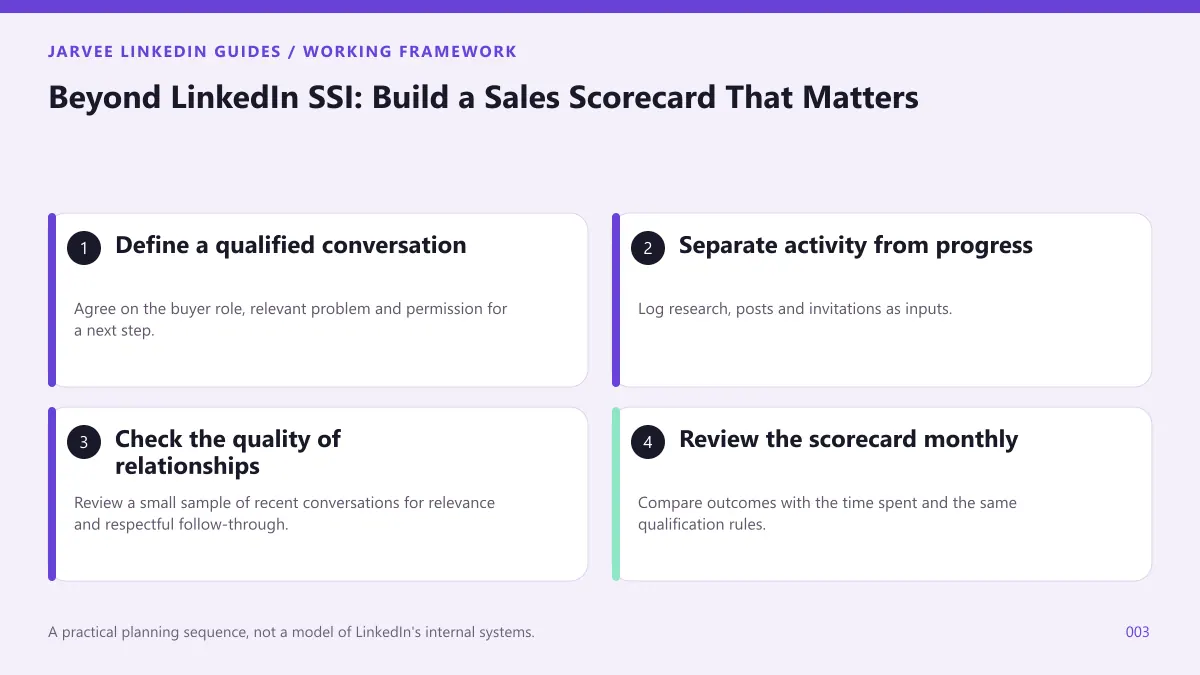
1. Define a qualified conversation
Agree on the buyer role, relevant problem and permission for a next step. A generic reply or accepted invitation alone should not meet that definition.
2. Separate activity from progress
Log research, posts and invitations as inputs. Track accepted next steps, attended discovery meetings and qualified opportunities as different outcomes.
3. Check the quality of relationships
Review a small sample of recent conversations for relevance and respectful follow-through. High activity with weak context is a coaching issue, not a reason to send more messages.
4. Review the scorecard monthly
Compare outcomes with the time spent and the same qualification rules. Keep notes about changes in audience or offer so the comparison remains interpretable.
An illustrative application
A hypothetical seller reduces the number of broad invitations and spends more time preparing relevant conversations. The useful question is whether qualified discussions improve, not whether a legacy score rises.
Replace a composite score with a chain of evidence
A composite score compresses different behaviors into one figure. That can make a dashboard easy to scan while hiding the distinction between useful activity and activity performed to improve the score. A sales review needs to preserve those distinctions because the next decision depends on them. More research, for example, is not the same problem as weak qualification or poor follow-through.
Write the evidence chain in ordinary language: a suitable person expressed a relevant need, agreed to explore it, participated in a useful conversation and met the team's opportunity definition. Every transition should have a reason. If the team cannot explain why a record advanced, the scorecard is rewarding a label rather than documenting progress.
Use a small review sample to improve definitions
Select a recent won project, a lost opportunity and a conversation that never became qualified. Review what was known at each stage without using the final outcome to rewrite history. Ask whether the original qualification decision was reasonable given the evidence available then. This separates a good process that sometimes loses from a weak process that occasionally gets lucky.
The exercise may reveal that 'interested' is too vague. One person wanted a public template; another described a funded project; a third accepted an invitation without asking anything. Those are different situations. Create labels that preserve the differences, and make the next action proportionate to each one instead of assigning all three a similar lead score.
Make coaching more specific
When results are weak, use the chain to locate the problem. If conversations rarely involve suitable people, review audience selection. If suitable people respond but meetings are unhelpful, review expectations and qualification. If proposals stall, investigate scope and decision ownership. A single social score cannot identify all of these causes reliably.
Keep the reporting burden manageable. A small team may need only a few well-defined fields and a regular review. Adding dozens of weak signals creates maintenance work and a false impression of precision. Prefer a record that people keep accurately over a sophisticated model populated with guesses, missing context and inconsistent stage changes.
Keep learning and revenue indicators separate
A new market may produce valuable learning before it produces qualified opportunities. Record that learning honestly: which assumptions were wrong, which roles understood the problem and which objections changed the offer. Do not relabel learning conversations as pipeline to make the channel look productive. Conversely, do not discard useful research because it did not immediately create a contract. A scorecard can show both kinds of progress when they have distinct definitions. This makes the review more informative and reduces pressure to optimize a composite social number that cannot explain what the business should do next.
A working exercise
Write the qualification rules above the sales scorecard so everyone reads the same definitions. Review one promising conversation and one poor-fit conversation together. Ask what evidence distinguishes them and whether the scorecard captures it. A score that rewards activity while missing those differences needs revision, even if its total looks impressive.
A review checklist
| Review point | Question to answer |
|---|---|
| Relevant person | Fits the written audience criteria |
| Expressed need | Describes a problem the business can address |
| Permission | Agrees to discuss a useful next step |
| Commercial status | Opportunity only after the team's qualification rule is met |
What to measure
Use counts and rates together: ten relevant replies from a small, focused list may mean more than a large reply total from unrelated contacts.
A mistake worth avoiding
Do not present SSI as a hidden ranking switch or purchase activity merely to improve a dashboard number.
Where a tool fits in this workflow
For a product-specific reference, review SMTasker LinkedIn automation overview. A product activity log and a sales scorecard answer different questions. The former can help inspect a configured task; the latter needs evidence about fit, expressed need and mutual progress. Do not turn successful execution into qualification or use a legacy social score to justify increasing account actions without reviewing the real relationship context. Any tool use must be assessed against LinkedIn’s rules; device type does not guarantee permission or freedom from restrictions.
Frequently asked questions
Is a high SSI score a sales result?
No. It is not a signed contract, a qualified opportunity or evidence that a specific audience wants your offer.
Can a small scorecard replace judgment?
No. Use it to make evidence consistent and identify questions that require a human review.
Continue with the next useful question
Related guidance: A weekly LinkedIn workflow for B2B teams; How the LinkedIn Feed Works: A Practical Guide to Relevance.
Official reference: LinkedIn: from SSI to AI. Check current official guidance and the options available in your own account when applying feature-specific advice.